Sunday, July 21, 2013

What is a Single Wefted Rug - Samples of Rug Backs

Here are a few samples of the Backs of Single Wefted rugs:
Please visit What is a Single Wefted Rug


This rug is woven in the usual Hamadan technique. The wefts are thicker than the wefts and the warps bend from the heavier wefts. With one shot of heavier weft the rug shows much white on the back.


This is a rare one. Maybe less than 1% of all Tekke Rugs are single wefted. Almost all Tekke Rugs have two rows of wefts in between each row of knots but a small and rare group only have one row of weft between each row of knots. The tekke used this technique to make pieces finer and more supple than normal.
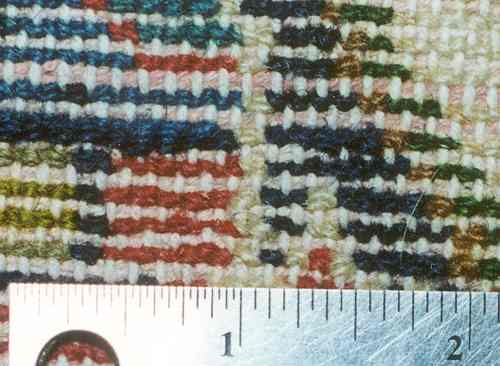


The Hamadan Weave is single wefted. There is one heavy weft between each row of knots and the warps lace around the wefts.


This yastik surprised me when I felt it. It is more solid then most really old yastik. Most have a floppy handle and this one is firm. The reason can be seen below. This is a rather rare single weft construction while almost all Turkish rugs have two shots of weft between each row of knots this yastik has but one.
Antique Bergama Area Yastik w/Single Weft Keshishian Collection
Bergama Area Yastik that I suspect is older than you would think.
Waps: Two ply Ivory wool.
Wefts 1 shot of two ivory wool singles.
Knot: Symetrical, 6.5 by 10.5 knots to the inch, 68 kpsi.
Size 35 by 18

Lilihan Mat Rug 2


Uploaded on Aug 30, 2010
Barry O'Connell looks at a nice little Lilihan Mat Rug at Richard Rothstein & Co. A leading Philadelphia Area Oriental rug store.
Please visit What is a Single Wefted Rug

What is a Single Wefted Rug

Here I look at ugs that use Single Weft construction. I hope it is useful.

In this first video I look at a Persian Single Wefted Rug Fragment. What I mean by that is that there is one shed of weft between each row of knots. Please review this because the number of wefts is one of the most important clues in Rug ID.


When we wish to ID a Rug we should first look a the back and among other things check to see if there is a single row of weft(s) or 2 or more rows of weft.
If there is only one row of wefts then we can rule out many possibilities including virtually all Turkish. Turkmen, Afghan, Chinese, Central Asian as well as most Persian and Caucasian Rugs. So then we know that it is likely to be one of:
and less commonly
About half of Bahktiari Rugs
10% of all Baluch Rugs
Here is a Malayer that I saw at Emanuel's in Seattle. I lost sound half way through but it is hopefully of value. 

Here is an Armenian single wefted Lilihan Rug that I saw at Richard Rothstein & Co. A leading Philadelphia Area Oriental rug store.

There are some old timers who claim "Single Wefted" is improper usage. At my behest the usage "Single Wefted" has  been adopted by resolution of The Academy of Oriental rugs in 2013. We use "Single Wefted" to describe a manner of rug technique that is crucial to understand in Rug ID.

What is a Double Wefted Rug - Pictures of Rug Backs

This post snowes examples of Rugs with double weft construction. For more information see

What is a Double Wefted Rug


Detail of Back - Afshar Rugs: The Bowen Tulip

Here we can see the classic medium ribbed back typical of Afshar Rugs. When one weft is pulled slightly tighter it separates the warps into two sets. In this case one is slightly tighter so it is medium depressed or ribbed. By the way look at the crude repair in the upper right corner. This is typical of the repairs that we see from Iran with rugs used in Iran.
The wefts in this schematic give you an idea of how they are in the Afshar rug above.


Bijar Rugs: Bidjar Rug Northwest Persia second quarter 20th c 
Bijar rugs are completely depressed but how can you tell by looking at the back. Every knot has two nodes but look carefully in the picture above. On the right hand side  look at the row of red knots next to the white area. Do you see how there is only one row of red. That means the other node is hidden in the foundation of the rug. keep look at every rug you see, you will keep seeing more and more.
Compare this schematic to the Bijar directly above.


Sultanabad Rugs: Antique Sultanabad Rug at Skinners
Notice how every other warp is raised like corduroy. That means it cannot be single wefted so it is double wefted. Don't be fooled by looks. Just because it is coarse and the weave is sloppy does not mean this is not a great rug. Old Sultanabad rugs can bring high prices.


Michael did not bother to describe this piece, not even giving size. He really didn't have to, the Bag speaks for itself. This bags are always larger in size than an average Khorjin panel and have outstanding silky wool. The backs are generally ribbed and medium depressed with brown wefts. Cotton is a sign of a late piece.
Peter Saunders published a related pieced which he labeled "Probably Afghahistan Mushwanee Tribal Visions Plate 15b. m


Ahar Rugs are very thick heavy durable rugs closely related to Heriz rugs. Look ar hge 2nd row from the top; one yellow node proves this is a deeply depressed double wefted 

Saturday, July 20, 2013

What is a Double Wefted Rug

Most Hand Woven Rugs are Double Wefted Rugs. That means that when the rug is woven on the loom after every row of knots there are two wefts that hold the rug together.
Sarouk Rug Back with Double Wefts

Virtually all Turkish, Indian, Pakistani, Caucasian, Turkmen  rugs are double wefted as are most Persian Rugs. 

Here we see a schematic of double wefts before and after each row of knots. The image above is balanced wefting which gives a flat back where both nodes of the knot is visible from the back. 
Here we see a schematic of a Bijar Rug weave. One weft is straight and rigid forcing the warps apart onto two planes and then a sinuous weft which hold it all together. As we can see in the top part of the drawing only one node of the knot is visible from the back and the other is buried deep in the foundation


Thursday, July 18, 2013

White Cotton Knots in a Wool Pile Rug

Sometimes we see stray white cotton knots in a wool pile rug. It is a simple matter and I look at it in this video from 2008.


Wednesday, July 17, 2013

RugID Juvals, Chuvals, Bedding Bags

Antique Qazvin Kurd Animal Bag

Textiles played a key role in the lives of tribal people particularly in the Middle East and Southwest Asia. They wove rugs to sleep on, rugs to roll out their bread; in fact if they needed it they were likely to weave it if at all possible. One common woven item was a bag. They came in all shapes and sizes.  Here I have a video on a bedding bag. If they had to move, household items were loaded in the bag and it was tied on the back of an animal from a burro, horse or camel. When they were not in use for mioving then they were often used in the yurt for storage or as a seat cushion.


Bedding Bags are often called Juvals or Chuvals. The proper translation from Turkmen is Chuval.
Many people consider the now famous Jenkins Salor chuval as the greatest turkmen chuval of all time.